
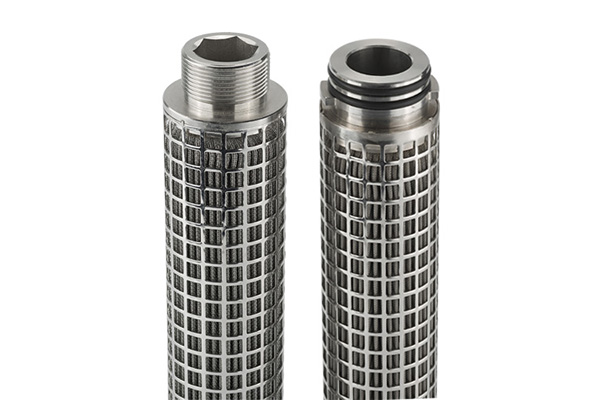
PHSF Stainless Steel Filter Cartridge
The PHSF is a sintered stainless steel fibre felt cartridge with a graded pore structure for improved depth filtration. Sintered fibre felt provides a more open, three-dimensional pore network than woven mesh, resulting in higher dirt-holding capacity and lower initial pressure drop.
- Micron Rating
- 5–60 µm
- Flow Rate
- 0.8–5.5 m³/h
- Max Temperature
- up to 480°C
- SKU
- PHSF
- Graded Pore Structure: Coarse upstream to fine downstream, so particulate distributes through the depth — markedly higher dirt-holding capacity than a surface filter.
- Sintered Fiber Medium: High-temperature sintering fuses the steel fiber matrix, giving a stable pore structure that will not shed or compact in service.
- Pleated for Area: Pleating multiplies effective area within the same envelope, extending intervals between change-outs.
- 480°C Rating: Handles hot process duty far beyond polymeric media limits.
- 5 bar Differential: Structural tolerance for high pressure drop and upset conditions.
- Cleanable and Reusable: All-stainless build supports repeated cleaning rather than replacement.
- Seal Options: NBR or silicone to suit the process fluid.
| Filter Media | 316L or 304 stainless steel sintered felt, pleated |
| Cage / Core / End Caps | 316L or 304 stainless steel |
| Pore Structure | Graded — coarse upstream to fine downstream |
| Micron Rating | 5–60 µm |
| Flow Rate | 0.8–5.5 m³/h |
| Max. Operating Temperature | 480°C |
| Max. Operating Differential Pressure | 5.0 bar |
| Standard Lengths | 5" to 40" |
| Seals | NBR, silicone |
- Polymer and Melt Filtration: High-viscosity, high-temperature streams needing depth capacity.
- Hot Process Liquids: Duties to 480°C outside the range of polypropylene or polyester elements.
- High Solids Loading: Streams where graded depth capacity extends service life over surface media.
- Cleanable Filtration Duty: Operations preferring reusable stainless elements to disposable cartridges.
The PHSF medium is manufactured by bonding randomly arranged stainless steel fibres under controlled heat and pressure, forming a rigid porous structure. The randomised fibre arrangement creates a tortuous flow path that captures particles throughout the depth of the medium rather than just at the surface. The graded density from outer to inner layer means large particles are captured early and finer particles are caught progressively deeper, maximising the dirt-holding capacity before differential pressure reaches the backwash threshold.
 English
  Spanish
  Arabic